Rooftop Solar Deployment Speed: Why Distributed Beats Utility
Why Rooftop Solar Deployment Speed Defines the Next Infrastructure Cycle
Rooftop solar deployment speed has become one of the most critical differentiators in European energy infrastructure. While utility-scale projects face multi-year grid connection queues and permitting bottlenecks, distributed rooftop systems can move from contract signing to revenue generation in weeks rather than years. This velocity advantage is reshaping how institutional capital approaches distributed rooftop solar infrastructure in Europe, not as a secondary asset class, but as a primary vehicle for deploying capital at pace. For investors seeking contracted infrastructure yield with near-term deployment visibility, the speed differential between centralised and distributed solar is no longer marginal. It is structural.
The Grid Bottleneck Creating a Two-Speed Market
Europe’s energy transition faces a paradox. Capital is available, policy support is strong, and solar technology costs have reached historic lows. Yet deployment of utility-scale projects continues to be constrained by infrastructure that cannot keep pace with demand. According to SolarPower Europe, grid connection delays now represent one of the primary barriers to scaling centralised solar capacity across major European markets.
In Germany, connection queues for large-scale projects can extend beyond five years. Italy and Spain have similar challenges. Their transmission infrastructure can’t keep up with new generation capacity. The result is a rising backlog of shovel-ready projects that need grid access. Capital is committed, but it remains unproductive.
Distributed rooftop solar operates under fundamentally different dynamics. Systems installed at the point of consumption bypass transmission constraints entirely. A commercial rooftop in Poland or the Netherlands can be assessed, permitted, installed, and commissioned within a single quarter. That rooftop solar deployment speed translates directly into faster revenue recognition, shorter capital deployment cycles, and reduced execution risk.
This distinction matters for portfolio construction. When a platform can deploy 20 rooftop systems in the time it takes to secure grid access for one utility-scale project, the compounding effect on portfolio growth becomes significant. The operational complexity shifts from waiting to executing.
Execution Capability as the Core Constraint
Speed without consistency creates its own risks. The challenge in distributed solar isn’t just about quickly deploying one system. It’s about rolling out hundreds of systems. These must have repeatable quality, standardised contracts, and predictable timelines. This needs to happen across various building types, ownership structures, and regulatory environments.
This is where platform architecture becomes determinative. A fragmented approach, treating each rooftop as an independent project, cannot achieve the deployment velocity that institutional portfolios require. The overhead of bespoke site assessment, custom contract negotiation, and ad-hoc installation management creates friction that compounds with scale.
Platforms designed for repeatability approach the problem differently. Standardised technical specifications reduce engineering variability. Pre-negotiated supply agreements compress procurement timelines. Centralised project management systems enable parallel deployment across multiple sites. The result is a deployment engine where adding the next rooftop becomes incrementally faster, not slower.
ENSOOL’s distributed solar platform is built on the idea that to deploy rooftop solar quickly and at scale, we need systems thinking instead of handling projects one by one. The difference between a developer and a platform lies precisely in this operational repeatability.
Comparing Deployment Models: Utility-Scale vs. Distributed Rooftop
The structural differences between centralised and distributed solar deployment extend beyond speed into risk profile, capital efficiency, and revenue timing. Understanding these distinctions is essential for infrastructure investors evaluating portfolio allocation.
| Factor | Utility-Scale Solar | Distributed Rooftop Solar |
|---|---|---|
| Typical deployment timeline | 2-5 years (including grid connection) | 8-16 weeks from contract to commissioning |
| Grid connection dependency | High—subject to transmission capacity | Low—connects behind the meter |
| Permitting complexity | Environmental impact assessments, land use approvals | Building permits, typically streamlined for commercial rooftops |
| Revenue commencement | Delayed until grid connection secured | Immediate upon commissioning |
| Counterparty structure | Single offtaker or merchant exposure | Diversified across multiple SME PPAs |
| Capital deployment efficiency | Large tranches, extended deployment periods | Continuous deployment, faster capital recycling |
For investors targeting infrastructure yield with deployment certainty, the distributed model offers a fundamentally different risk-return profile. The trade-off is operational complexity, managing many small assets rather than a few large ones. This is precisely why aggregation platforms become essential to unlocking the asset class at institutional scale.
Market Conditions Accelerating Adoption
Several structural factors are converging to make rooftop solar deployment speed increasingly valuable. Energy price volatility across Europe has shifted SME behaviour from passive consumption to active energy management. According to Eurostat, non-household electricity prices remain elevated above pre-2021 baselines across most EU markets, creating sustained economic incentive for on-site generation.
Simultaneously, grid congestion is increasing the system value of distributed generation. When transmission infrastructure is constrained, electrons generated and consumed locally reduce network stress. Some markets are beginning to reflect this value in regulatory frameworks, though the trend remains early-stage.
For SMEs, the calculus has simplified. A rooftop PPA offers price visibility for ten to fifteen years, reduces exposure to wholesale market fluctuations, and requires no capital expenditure. The decision is increasingly economic rather than environmental. This demand-side pull, combined with supply-side deployment efficiency, creates conditions where distributed solar can scale faster than centralised alternatives.
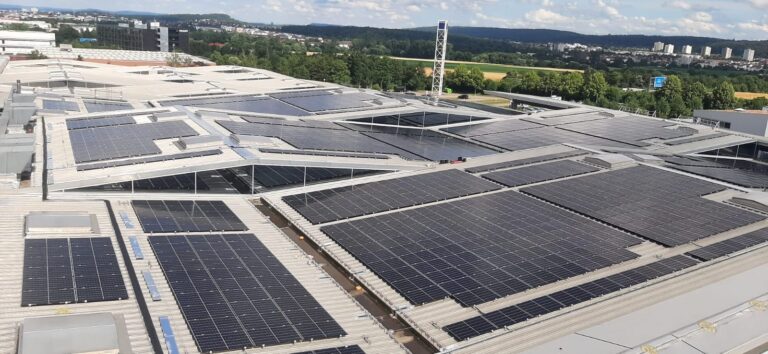
The Stuttgart 2MW Industrial Rooftop Solar: How Distributed Assets Scale project illustrates how individual commercial installations can be structured for portfolio aggregation, demonstrating both the deployment velocity and the contractual architecture that institutional investors require.
Frequently Asked Questions
How long does it typically take to deploy a commercial rooftop solar system in Europe?
For standardised commercial installations, the timeline from signed contract to commissioned system typically ranges from eight to sixteen weeks. This includes site assessment, permitting, procurement, installation, and grid connection. The specific duration varies by market, with Germany and the Netherlands generally offering faster permitting than Southern European markets; however, distributed rooftop systems consistently deploy faster than utility-scale projects that require transmission-level grid access.
Why is rooftop solar deployment speed faster than utility-scale solar?
Distributed rooftop systems connect behind the meter at the point of consumption, bypassing transmission grid connection queues that can delay utility-scale projects by years. Permitting requirements are also typically lighter for building-mounted systems compared to ground-mount installations requiring environmental assessments and land use approvals. The combination of simpler permitting, no grid queue dependency, and smaller individual project scope enables dramatically faster deployment cycles.
What is the typical PPA length for commercial rooftop solar in Europe?
Commercial rooftop PPAs in Europe typically range from ten to twenty years, with fifteen years being common for institutional-grade portfolios. Longer contract durations provide greater revenue visibility and support infrastructure-style valuations, though they require robust counterparty credit assessment and contract structuring to manage SME default risk across the portfolio.
How do investors access distributed rooftop solar as an asset class?
Direct investment in individual rooftop systems is typically impractical for institutional investors due to small ticket sizes and operational fragmentation. Aggregation platforms that assemble distributed assets into portfolios with standardised contracts, centralised operations, and diversified counterparty exposure provide the access point. These platforms transform thousands of small assets into institutional-grade infrastructure portfolios with predictable cashflows.
Which European markets offer the fastest rooftop solar deployment conditions?
Markets combining streamlined permitting, strong solar irradiance, and supportive distributed generation policy currently include the Netherlands, Germany, and Poland. Poland in particular offers an attractive combination of high SME energy costs, large industrial rooftop inventory, and growing regulatory support for behind-the-meter generation. Market selection significantly impacts achievable deployment velocity and portfolio growth rates.
The next phase of European solar infrastructure will not be defined solely by installed capacity. It will be defined by how quickly that capacity can be deployed, contracted, and aggregated into portfolios that meet institutional requirements. Rooftop solar deployment speed is not merely an operational metric, but instead, it is becoming the primary determinant of which platforms can convert Europe’s vast distributed generation potential into investable infrastructure at scale.