Stuttgart 2MW Industrial Rooftop Solar: How Distributed Assets Scale
A 2-megawatt rooftop solar installation on an industrial facility in Stuttgart may not make headlines on its own. Taken as part of a growing portfolio of similar assets across Germany and Central Europe, it represents exactly the kind of deployment that defines the next phase of the continent’s energy transition – distributed, repeatable, and structurally underappreciated.
The Asset: Commercial Rooftop at Industrial Scale
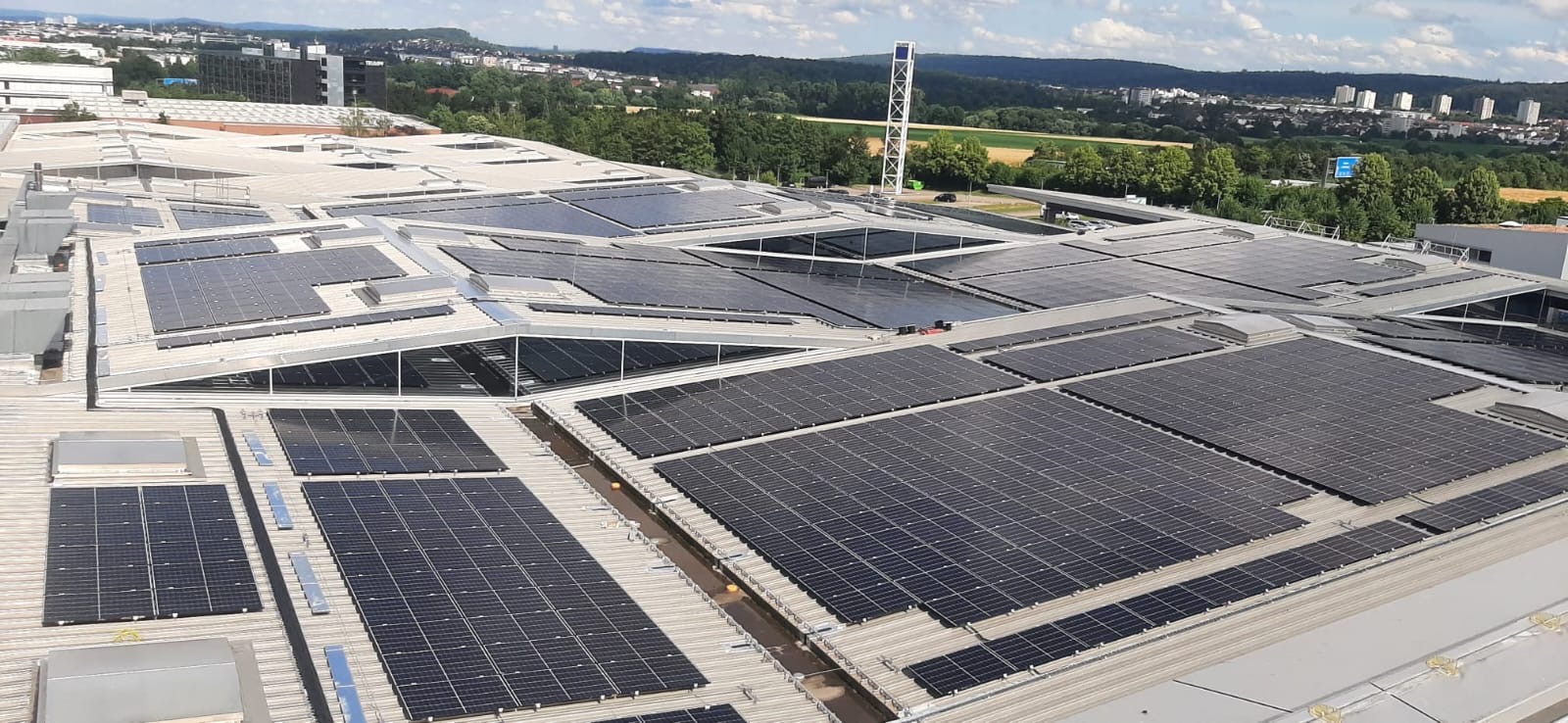
The Stuttgart project covers a large commercial and industrial rooftop in the greater Stuttgart metropolitan area – one of Germany’s most economically active regions, home to a dense concentration of manufacturing, logistics, and automotive supply chain facilities. At 2MW installed capacity, the system generates sufficient electricity to meaningfully offset the host facility’s consumption while feeding surplus generation into the grid under a structured offtake arrangement.
The installation uses standard monocrystalline panels in a ballasted flat-roof configuration – a proven, low-intervention approach that avoids structural modifications and minimises deployment timelines. From site assessment to commissioning, projects of this type can typically be completed within eight to twelve weeks, a critical advantage over utility-scale alternatives that often face multi-year connection queues.
Why This Type of Asset Matters for Portfolio Building
Individual rooftop projects like Stuttgart are not the story in isolation. The story is what becomes possible when the same process – site qualification, system design, installation, PPA contracting, and asset management – can be executed repeatedly across dozens or hundreds of comparable rooftops.
At that point, the economics of distributed solar shift. Revenue becomes diversified across multiple counterparties and geographies. Operational costs per megawatt decline as processes are standardised. And the portfolio begins to exhibit the cashflow predictability and long-term revenue visibility that characterises institutional infrastructure – rather than a collection of standalone development projects.
This is the transition that ENSOOL’s distributed solar platform is designed to enable. The Stuttgart installation is one node in a broader network of assets being aggregated into a structured, scalable portfolio across Germany, Poland, and beyond.
Germany as a Distributed Solar Market
Germany remains Europe’s most mature solar market by installed capacity, with a regulatory environment that has progressively supported distributed generation alongside utility-scale development. The commercial and industrial segment has grown particularly strongly, driven by sustained electricity price pressure on SMEs and the availability of competitive self-consumption and feed-in arrangements.
The country’s high density of industrial buildings – warehouses, logistics centres, production facilities – provides an extensive inventory of technically suitable rooftops. Combined with a well-developed grid infrastructure and strong institutional appetite for contracted renewable assets, Germany represents one of the most structurally attractive markets for rooftop solar aggregation at scale.
Frequently Asked Questions
How long does it take to deploy a 2MW rooftop solar system in Germany?
For a straightforward flat-roof commercial installation, the full process from site assessment to grid connection typically takes between eight and sixteen weeks, depending on grid operator timelines and permitting requirements in the specific municipality.
What is the typical offtake structure for industrial rooftop solar in Germany?
Most commercial installations use a combination of direct self-consumption by the host facility and a structured PPA or feed-in tariff for surplus generation. Long-term PPAs with terms of ten to twenty years are increasingly common, providing revenue visibility for both the asset owner and the host.
How does a 2MW rooftop installation fit into a larger infrastructure portfolio?
At the individual asset level, 2MW is a relatively modest installation. Within an aggregated portfolio of fifty or more similar assets, the combined capacity becomes meaningful at institutional scale – typically above 100MW – with diversified counterparties and geographies that reduce concentration risk.
What makes Germany attractive for distributed solar investment compared to other European markets?
Germany combines a strong solar resource (particularly in the south and west), an extensive industrial rooftop inventory, a mature regulatory framework, and deep institutional capital markets. Grid infrastructure quality and permitting certainty are higher than in many emerging European solar markets, reducing execution risk.