Best Company Large-Scale Solar Construction Europe: 5 Essential Facts Now
Best Company for Large-Scale Solar Construction in Europe?
The question “Best Company for Large-Scale Solar Construction in Europe?” does not have a single correct answer – because the answer depends entirely on what type of solar construction is being evaluated. Europe’s solar market now spans utility-scale ground-mount projects, commercial and industrial rooftop systems, and emerging distributed portfolio models that aggregate smaller assets into institutional-grade infrastructure. According to SolarPower Europe, the EU exceeded 400 GW of total installed solar capacity by the end of 2024, with distributed rooftop systems representing a growing share. For institutional investors and infrastructure fund managers, the more useful question is not which single company leads, but which model of large-scale solar construction in Europe delivers the strongest risk-adjusted returns, fastest deployment timelines, and most scalable long-term structure. That distinction increasingly favours platform-based aggregation over traditional project-by-project development.
Why the Best Company for Large-Scale Solar Construction Depends on the Model
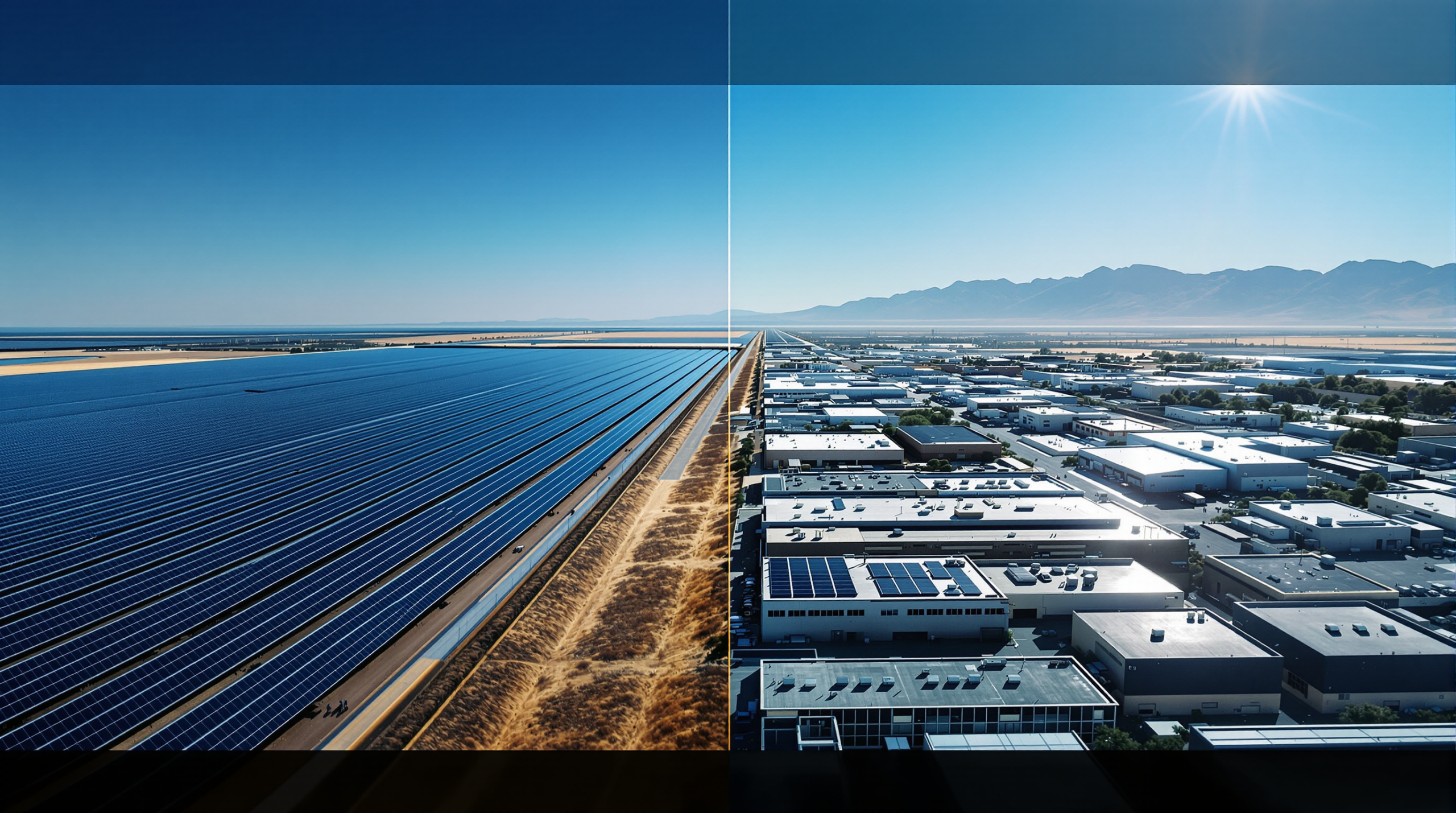
Europe’s solar construction landscape is broad. On one end, utility-scale developers like Lightsource bp, Goldbeck and Statkraft build large ground-mount plants, often exceeding 50 MW per site. These projects are well understood by institutional capital and benefit from established financing structures. However, they face growing constraints. Grid connection queues in markets like Spain, Italy, and Germany now stretch years in some cases, and permitting complexity continues to increase. On the other end, distributed rooftop solar infrastructure in Europe is scaling rapidly across commercial and industrial buildings. Factories, logistics centres, and warehouses represent an enormous surface area that can host solar generation directly at the point of consumption.
The challenge with distributed solar has historically been fragmentation. Thousands of individual installations, each developed independently, make it difficult to achieve the portfolio scale that infrastructure investors require. But that dynamic is shifting. Platform models are emerging that standardise site acquisition, system deployment, and long-term power purchase agreements across hundreds of rooftops. This approach transforms what was once a collection of small projects into a repeatable, scalable infrastructure operation. Understanding this distinction is essential when evaluating the best company for large-scale solar construction in Europe today.
Structural Challenges Facing Large-Scale Solar Construction in Europe
Several structural forces are reshaping which solar construction models deliver the most value. Grid congestion across major European markets is a primary constraint for utility-scale projects. In markets like Poland, the Netherlands, and parts of Germany, new grid connections for large plants face multi-year delays. Meanwhile, distributed rooftop systems bypass many of these bottlenecks because they generate electricity at the point of consumption, reducing transmission dependency. As explored in Distributed Solar Infrastructure: 5 Essential Platform Facts, this behind-the-meter advantage is becoming a significant differentiator.
Permitting represents another structural barrier. Large ground-mount solar farms require environmental impact assessments, land-use approvals, and community engagement processes that can delay projects by 12 to 36 months. Rooftop installations on existing commercial buildings face considerably lighter regulatory requirements in most EU jurisdictions, enabling faster deployment and faster revenue generation. For investors evaluating the best company for solar construction in Europe, speed-to-deployment is increasingly a deciding factor.
Energy pricing dynamics also play a critical role. According to Eurostat, non-household electricity prices across the EU remain structurally above the averages seen over the last decade. This has accelerated SME demand for on-site solar generation, creating a growing pool of willing offtakers for long-term PPAs. That demand-side pull is a key reason why distributed solar construction is gaining ground as an institutional-quality infrastructure segment. The Solar Infrastructure Platform: 7 Essential Benefits Now analysis details how these dynamics converge to support platform-scale deployment.
Forward Outlook: How the Best Large-Scale Solar Construction Models Will Evolve
Looking ahead, the companies best positioned for large-scale solar construction in Europe will likely be those that combine operational repeatability with portfolio-level thinking. Utility-scale developers will continue to play a vital role, particularly in markets with available grid capacity and streamlined permitting. But the fastest-growing segment – and the one attracting increasing institutional attention – is aggregated distributed solar.
Industry estimates suggest Europe holds roughly 2 to 3 TWp of rooftop solar potential, several times the continent’s current installed capacity. Unlocking that potential at scale requires platforms capable of standardising deployment across diverse building types, ownership structures, and regulatory environments. ENSOOL’s distributed solar platform is being built around precisely this thesis – aggregating SME rooftops into long-duration portfolios with contracted cashflows that institutional investors can underwrite.
The forward trajectory is clear. As grid constraints tighten and distributed generation economics improve, the definition of “large-scale” solar construction in Europe is expanding beyond single mega-projects to include aggregated portfolios spanning hundreds of sites. The best companies in this space will be those that master the systems, processes, and operational consistency required to repeat deployment at that scale.
| Dimension | Utility-Scale Solar Construction | Aggregated Distributed Solar Construction |
|---|---|---|
| Typical project size | 50-500 MW per site | 50-500 kW per site, aggregated into 100+ MW portfolios |
| Grid connection timeline | Often 2-5 years in congested markets | Weeks to months (behind-the-meter) |
| Permitting complexity | High – environmental and land-use approvals | Lower – existing commercial buildings |
| Revenue model | Wholesale market or utility PPA | Long-term commercial PPA with SME offtakers |
| Counterparty diversification | Single or few offtakers per project | Hundreds of diversified offtakers per portfolio |
| Scalability constraint | Land availability, grid access | Operational repeatability, platform capability |
Frequently Asked Questions About Best Company for Large-Scale Solar Construction in Europe?
Who is the best company for large-scale solar construction in Europe?
How does distributed solar construction compare to utility-scale in Europe?
What makes large-scale solar construction in Europe attractive for institutional investors?
Which European markets are best suited for large-scale solar construction?
The question of the best company for large-scale solar construction in Europe is evolving alongside the market itself. As distributed solar matures from fragmented installations into aggregated, platform-managed portfolios, the competitive landscape is widening beyond traditional utility-scale developers. The companies that will define this next phase are those building repeatable systems for deployment, retention, and long-term asset management across hundreds of sites – turning Europe’s rooftops into the institutional-grade energy infrastructure the market increasingly demands.