What is Agrivoltaics and How Does It Work? 5 Essential Facts
What Is Agrivoltaics and How Does It Work?
What is agrivoltaics and how does it work? Agrivoltaics – also called agrophotovoltaics or solar sharing – is the practice of co-locating solar energy generation and agricultural activity on the same land. Elevated or spaced solar panels are installed above or between crops, allowing farming and electricity production to operate simultaneously. The concept directly addresses one of the most persistent tensions in the energy transition: competition between renewable energy deployment and agricultural land use. According to the Fraunhofer Institute for Solar Energy Systems, which pioneered early agrivoltaic research in Germany, dual-use systems can retain 80% or more of original crop yields while generating significant solar output. As European countries accelerate toward their 2030 renewable targets, agrivoltaics is gaining traction as a land-efficient model that complements broader distributed rooftop solar infrastructure in Europe by expanding the surface area available for generation without displacing food production.
How Agrivoltaics Works: The Structural Opportunity
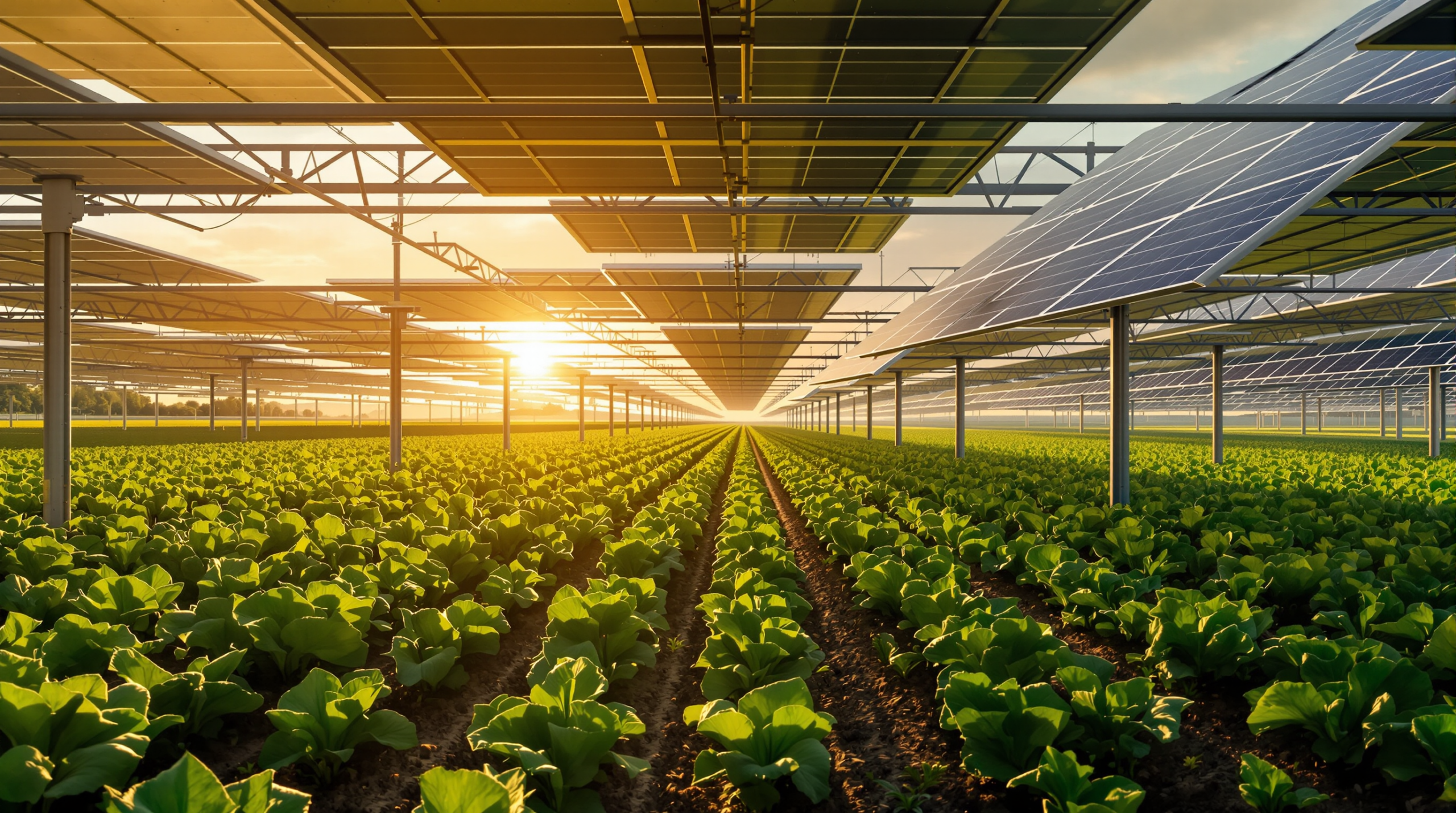
Understanding how agrivoltaics works requires looking at both the engineering and the economics. Systems are typically designed in one of two configurations: elevated structures that raise panels several metres above the ground, allowing conventional farming equipment to operate beneath, or ground-level interrow installations where panels are spaced apart to let light reach crops planted between rows. The panel tilt, height, spacing, and transparency are calibrated based on the specific crops being grown, local climate conditions, and energy output targets.
The opportunity is considerable. The European Commission’s Joint Research Centre has identified agrivoltaics as a key pathway for scaling solar without converting arable land exclusively to energy production. Industry estimates suggest that even modest deployment across Europe’s agricultural land could unlock hundreds of gigawatts of additional solar capacity. Countries like France, Italy, and Germany have already introduced regulatory frameworks or subsidy mechanisms that specifically incentivize agrivoltaic installations, distinguishing them from standard ground-mount solar.
For investors evaluating the energy transition landscape, agrivoltaics represents a third category between utility-scale ground-mount solar and distributed rooftop systems. It occupies a middle ground: larger than rooftop installations but more community-integrated than conventional solar farms. This positioning creates both opportunities and structural challenges that are worth examining closely, particularly for those already assessing Solar Infrastructure Platform: 7 Essential Benefits Now.
How Does Agrivoltaics Work Amid Europe’s Land Use Constraints?
The structural challenge facing agrivoltaics is not technological – it is institutional. Land use permitting across European markets remains complex. Agricultural zoning laws, environmental impact assessments, and grid connection requirements create layered approval processes that vary significantly between countries and even between municipalities. This fragmentation mirrors the broader challenge in distributed solar, where assets exist at scale but lack the aggregation infrastructure to become institutional-grade.
Agronomic complexity adds another dimension. Not all crops respond equally well to partial shading. Research from the French National Institute for Agriculture, Food and Environment (INRAE) shows that certain shade-tolerant crops – lettuce, berries, potatoes – perform well under agrivoltaic systems, while sun-intensive crops like maize may see more significant yield reductions. System design must therefore be crop-specific, which limits standardization and increases project development costs relative to conventional solar.
Financing structures also remain immature. Most agrivoltaic projects today are developed on a project-by-project basis, lacking the portfolio-level aggregation that institutional investors require. This is a familiar constraint. As explored in Scaling Global Solar Infrastructure: 3 Critical Barriers, the gap between fragmented asset deployment and scalable portfolio formation is where much of the distributed energy market remains stuck. Until agrivoltaic projects can be standardized, contracted under long-term power purchase agreements, and bundled into diversified portfolios, the sector will struggle to attract infrastructure-grade capital at scale.
What Is Agrivoltaics’ Role in the Forward Energy Mix?
Looking ahead, agrivoltaics is positioned to play a meaningful but specific role within Europe’s broader solar deployment strategy. SolarPower Europe’s market outlook highlights that the EU needs to install well over 50 GW of new solar capacity annually to meet its climate targets. Agrivoltaic systems will contribute a growing share of that pipeline, particularly in land-constrained markets where competing demands for space make pure ground-mount development politically or practically difficult.
The forward outlook for agrivoltaics depends on three factors: regulatory clarity, financing innovation, and operational scalability. France’s 2023 legislation defining agrivoltaic standards set an important precedent, and Germany’s revised Renewable Energy Sources Act (EEG) includes specific provisions for dual-use systems. As these frameworks mature, project bankability improves.
However, for the distributed solar market as a whole, the most scalable near-term opportunity remains commercial and industrial rooftop deployment. Rooftop systems bypass land use conflicts entirely, connect directly at the point of consumption, and are deployable within weeks rather than months. Platforms like ENSOOL’s distributed solar platform are designed precisely for this segment – aggregating SME rooftops into institutional-grade portfolios with long-term PPAs, turning fragmented assets into structured infrastructure. Agrivoltaics complements this approach by expanding total addressable generation capacity, but rooftop aggregation remains the faster path to scaled deployment.
| Dimension | Agrivoltaic Systems | Commercial Rooftop Solar |
|---|---|---|
| Land use | Dual-use: agriculture + energy | No additional land required |
| Permitting complexity | High – agricultural zoning, environmental review | Lower – building permits, grid notification |
| Deployment timeline | 6-18 months typical | 4-12 weeks typical |
| Standardization potential | Limited – crop and site-specific design | High – repeatable across building types |
| Portfolio aggregation readiness | Early stage – mostly project-by-project | Maturing – platform models emerging |
| Institutional investor accessibility | Limited without aggregation layer | Increasing via PPA-backed portfolios |
Frequently Asked Questions About Agrivoltaics and How It Works
What is agrivoltaics and how does it work for farmers?
How does agrivoltaics compare to conventional ground-mount solar?
Which European countries have agrivoltaics regulations in place?
Can agrivoltaic projects attract institutional investment?
Agrivoltaics represents a meaningful expansion of Europe’s solar generation potential, particularly in markets where land availability constrains deployment. Yet the sector’s path to institutional scale depends on solving the same structural challenge that defines distributed energy more broadly: aggregation. Whether the asset sits on a farm or a factory roof, the transition from fragmented project to scalable infrastructure requires platforms capable of standardizing deployment, contracting long-term revenue, and building portfolios that institutional capital can access. That structural layer is what will ultimately determine how fast Europe’s solar capacity translates into investable infrastructure.