How Do Solar Farm Developers Make Money? 7 Essential Models Now
How Do Solar Farm Developers Make Money?
How do solar farm developers make money? The answer depends on the type of solar asset, the revenue model, and the market structure in which the developer operates. At the most fundamental level, solar farm developers generate revenue by building solar generation capacity and monetising the electricity it produces – either through wholesale market sales, feed-in tariffs, or long-term power purchase agreements (PPAs). Some developers build and sell assets outright, while others retain ownership to capture recurring cashflows over 20 to 30 years. As the European solar market matures, the distinction between these models is becoming more important. According to SolarPower Europe, the EU’s installed solar capacity exceeded 400 GW by the end of 2024, creating an increasingly competitive landscape where how solar farm developers make money is shaped less by technology costs and more by commercial structure, portfolio scale, and access to institutional capital.
How Do Solar Farm Developers Make Money Through Revenue Models?
Understanding how solar farm developers make money requires a closer look at the core revenue streams available to them. The most common model involves developing a solar project – securing land or rooftop access, obtaining permits, procuring equipment, overseeing construction – and then selling the completed asset to an investor or utility. This “develop and flip” model generates upfront development margins, typically between 10 and 25 percent depending on market maturity and project risk. The developer captures value from the spread between total development cost and the asset’s fair market value at the point of sale.
The second and increasingly dominant model involves retaining ownership of the asset and earning revenue from electricity generation over time. In this model, solar developers make money through long-term PPAs with corporate or industrial offtakers, guaranteeing predictable cashflows for 10 to 25 years. This approach is particularly attractive for developers building portfolios of distributed rooftop solar infrastructure in Europe, where contracted revenue from many smaller sites can aggregate into institutional-grade yield.
A third revenue pathway involves merchant exposure – selling electricity at prevailing wholesale market prices without a fixed contract. While this can deliver higher returns during periods of elevated power prices, it introduces volatility that most institutional investors seek to avoid. In practice, most sophisticated solar developers blend these approaches, contracting a portion of output under PPAs while retaining some merchant upside.
How Solar Farm Developers Make Money in Distributed vs. Utility-Scale Markets
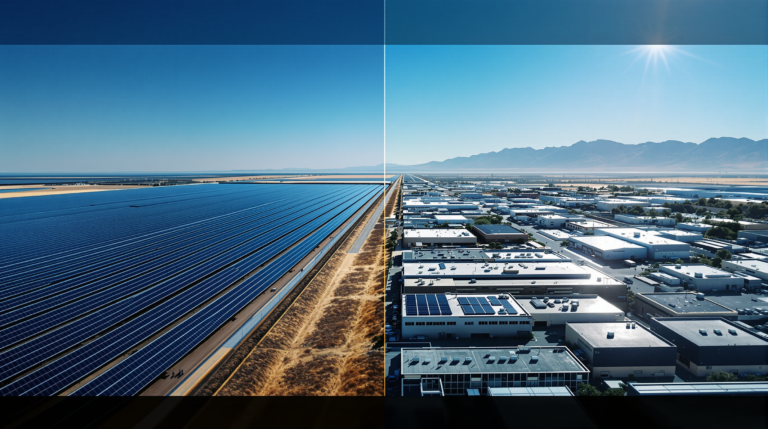
The economics of how solar farm developers make money differ significantly between utility-scale ground-mounted projects and distributed rooftop installations. Utility-scale developers benefit from economies of scale in procurement and construction but face growing challenges with grid connection timelines, permitting complexity, and land acquisition. In some European markets, connection queues now stretch for years, delaying revenue generation substantially.
Distributed solar developers operate under a different model entirely. By installing systems directly at the point of consumption – on commercial and industrial rooftops – they bypass many grid constraints and can deploy systems in weeks rather than years. The revenue model here typically centres on long-term PPAs with the building occupant, who benefits from below-market electricity prices and reduced exposure to volatility. As recent European Rooftop Solar Market: 7 Critical Insights Now analysis confirms, SME demand for on-site generation is accelerating across markets like Germany, Poland, Italy, and the Netherlands.
However, distributed solar presents its own challenge. Individual rooftop projects are small, operationally complex, and difficult to finance at scale. This is precisely the structural gap that aggregation platforms – such as ENSOOL’s distributed solar platform – are designed to address. By standardising deployment across hundreds of sites and packaging them into portfolios, developers can transform fragmented rooftop assets into infrastructure-grade investments with predictable, contracted cashflows.
| Dimension | Utility-Scale Solar Development | Distributed Rooftop Solar (Aggregated) |
|---|---|---|
| Primary revenue model | Wholesale market sales, auction-based PPAs | On-site PPAs with commercial/industrial offtakers |
| Deployment timeline | 2-5 years (permitting + grid connection) | Weeks to months per site |
| Capital intensity per project | High (single large asset) | Lower per site, higher aggregate volume |
| Grid dependency | Full – requires grid connection and capacity allocation | Minimal – behind-the-meter generation |
| Scalability constraint | Land, permits, grid access | Operational repeatability and aggregation capability |
| Revenue predictability | Variable (merchant exposure common) | High (long-term contracted PPAs) |
| Investor profile | Infrastructure funds, utilities | Yield-seeking institutional capital |
How Solar Developers Make Money as the Market Shifts Toward Platform Models
The next evolution in how solar farm developers make money is being shaped by the transition from project-level development to platform-based aggregation. Historically, solar developers have operated as project companies – identifying opportunities, executing construction, and either selling or holding individual assets. That model works, but it has inherent limits when applied to distributed solar, where the value lies not in any single installation but in the portfolio effect across hundreds or thousands of sites.
Platform models change this equation fundamentally. When a developer can repeat the same deployment process across many rooftops, geographies, and counterparties while maintaining operational consistency, the business begins to resemble infrastructure rather than project development. Revenue becomes more predictable, counterparty risk diversifies, and the portfolio itself becomes financeable at institutional scale. According to Eurostat, non-household electricity prices across the EU remain structurally above the historical baselines of the previous decade, reinforcing the economic case for long-term solar PPAs. For insights into how construction-scale execution underpins this model, Best Company Large-Scale Solar Construction Europe: 5 Essential Facts Now provides relevant context on operational capability requirements.
This structural shift explains why solar farm developers increasingly make money not just from generating electricity, but from building scalable systems that can deploy, retain, and compound assets over time. The margin moves from development fees to long-duration portfolio yield – a fundamentally different proposition for capital markets.
Frequently Asked Questions About How Do Solar Farm Developers Make Money?
How do solar farm developers make money from power purchase agreements?
What is the difference between how utility-scale and distributed solar developers make money?
How do solar developers make money by retaining assets instead of selling them?
How do solar farm developers make money in a market with falling panel prices?
The question of how solar farm developers make money is ultimately a question about market structure. As Europe’s solar capacity continues to expand and distributed generation gains ground, the developers best positioned to capture long-term value will be those building repeatable, aggregated portfolios rather than isolated projects. ENSOOL is building its platform around precisely this thesis – turning fragmented rooftop assets into structured, institutional-grade solar infrastructure with contracted, predictable cashflows across European markets.