How Much Does It Cost to Build a Solar Farm in Europe? €400k-€800k/MWp Now
How Much Does It Cost to Build a Large-Scale Solar Farm in Europe?
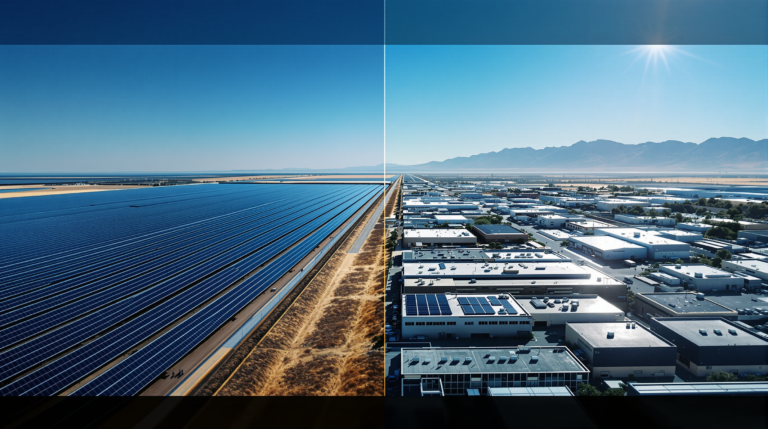
How much does it cost to build a large-scale solar farm in Europe? For utility-scale ground-mounted projects, the fully installed cost typically falls between €400,000 and €800,000 per MWp, depending on market, grid connection complexity, land acquisition, and permitting timelines. According to the International Energy Agency, solar PV capital costs have declined significantly over the past decade, but European projects still carry a premium compared to global averages due to higher labour costs, environmental compliance requirements, and increasingly constrained grid infrastructure. These figures represent the capital expenditure alone – they do not account for the growing structural costs of delayed grid connections, which in some markets now add years to project timelines. Understanding the true cost of building a solar farm in Europe requires looking beyond panels and inverters toward the full infrastructure picture, including how distributed rooftop solar infrastructure in Europe is emerging as a structurally different alternative with its own cost profile.
What Drives the Cost to Build a Large-Scale Solar Farm in Europe Today?
The cost to build a large-scale solar farm in Europe is shaped by several interconnected factors that vary significantly across geographies. Hardware – modules, inverters, mounting structures – now represents a smaller share of total project costs than it did five years ago. According to SolarPower Europe, module prices have dropped to historic lows, but balance-of-system costs, grid connection fees, and permitting expenses have not followed the same trajectory. In markets like Germany, Spain, and Italy, grid connection queues have become a binding constraint, with some projects waiting three to five years for capacity allocation.
Land acquisition adds another variable. Southern European markets offer stronger irradiation but face increasing competition for suitable sites. Northern markets like the Netherlands and Poland present lower land costs in some regions but require higher capacity installations to achieve comparable energy yields. Environmental impact assessments, which are now mandatory under updated EU directives, can add six to eighteen months and significant advisory costs to project development timelines.
Financing costs also matter. With European interest rates remaining above pre-2022 levels, the weighted average cost of capital for solar infrastructure projects has increased. Industry estimates suggest that financing now adds 15-25% to total lifetime project costs compared to the low-rate environment of 2020-2021. For institutional investors evaluating European solar farm construction costs, the all-in delivered cost per MWh – not just the upfront capital expenditure – is the more relevant metric. Recent analysis in the European Rooftop Solar Market: 7 Critical Insights Now report highlights how these dynamics are reshaping capital allocation across the solar value chain.
Large-Scale Solar Farm Costs in Europe vs. Distributed Rooftop Alternatives
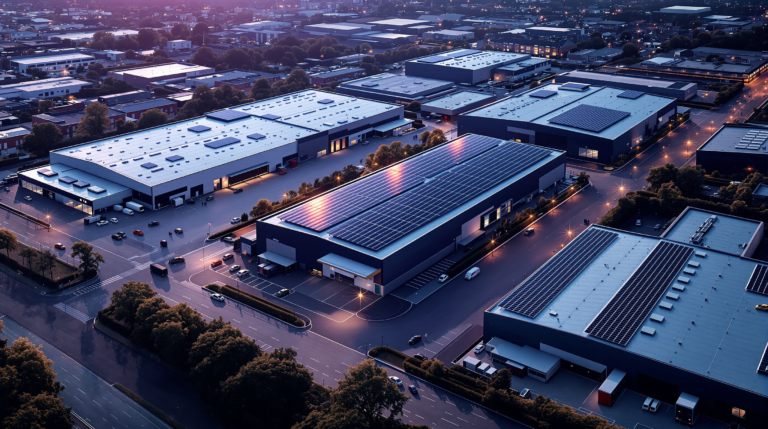
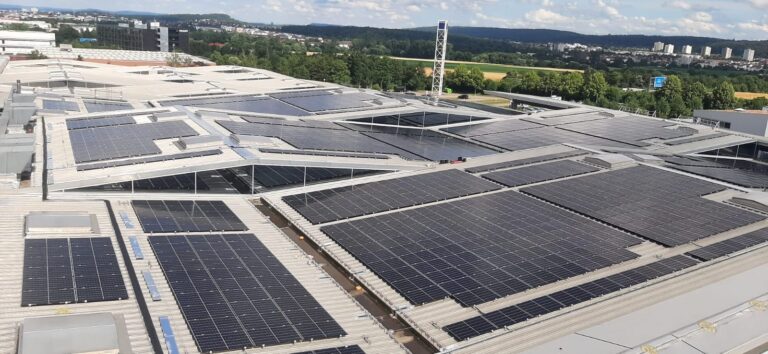
When asking how much it costs to build a large-scale solar farm in Europe, it is important to compare this against the distributed alternative. Rooftop solar on commercial and industrial buildings operates in a fundamentally different cost structure. Individual system sizes are smaller – typically 50 kWp to 500 kWp – but they bypass many of the cost drivers that inflate utility-scale budgets: no land acquisition, minimal grid upgrade requirements, and significantly shorter permitting timelines.
The trade-off is operational complexity. A single utility-scale solar farm delivers concentrated output from one site. Achieving the same aggregate capacity through distributed rooftop systems requires deploying across dozens or hundreds of buildings, each with its own structural assessment, lease arrangement, and interconnection point. This is precisely why aggregation platforms are becoming essential. Without standardised processes, the per-unit transaction cost of distributed solar remains too high for institutional capital. Platforms like ENSOOL’s distributed solar platform are designed to address this structural gap by turning fragmented rooftop assets into portfolio-grade infrastructure.
| Factor | Utility-Scale Solar Farm | Distributed Rooftop Solar (Aggregated) |
|---|---|---|
| Typical cost per MWp (installed) | €400,000 – €800,000 | €600,000 – €1,000,000 |
| Grid connection timeline | 2 – 5 years in congested markets | Weeks to months (behind-the-meter) |
| Land / site acquisition | Required – increasingly competitive | Existing rooftops – lease-based |
| Permitting complexity | High – environmental assessments required | Low to moderate – building-level permits |
| Revenue model | Wholesale market / CfD / merchant | Long-term PPA with SME offtaker |
| Scalability model | Site-by-site development | Platform-driven repeatability |
| Time to first revenue | 3 – 6 years from development start | 3 – 9 months from contract signing |
The Forward Cost Outlook for Building Solar Farms Across Europe
Looking ahead, the cost to build a large-scale solar farm in Europe is unlikely to decline as sharply as it did in the previous decade. Module prices are already near manufacturing cost floors, and the remaining cost reductions depend on regulatory streamlining, grid infrastructure investment, and supply chain localisation – all of which move slowly. The EU Solar Energy Strategy has set ambitious targets, but execution depends on member-state-level permitting reform and transmission network expansion that remains behind schedule.
Meanwhile, distributed solar costs benefit from a different trajectory. As aggregation platforms mature and standardise deployment processes, the effective per-MWp cost of rooftop portfolios is expected to decline through operational efficiency rather than hardware price drops. The European Rooftop Solar Market: 7 Critical Insights Now analysis underscores how this shift is already visible in leading markets like Germany, the Netherlands, and Poland.
For investors asking how much it costs to build a solar farm in Europe, the answer increasingly depends on which type of solar infrastructure is being considered. Utility-scale projects offer concentrated capacity but face growing structural bottlenecks. Distributed rooftop portfolios offer contracted cashflows and faster deployment, but require platform-level aggregation to achieve institutional scale. Both pathways will be essential to meeting Europe’s energy transition targets, but the cost dynamics and risk profiles are diverging.
Frequently Asked Questions
How much does it cost to build a large-scale solar farm in Europe per megawatt?
What are the biggest cost drivers for European solar farm construction?
Is distributed rooftop solar cheaper than building a large-scale solar farm in Europe?
How long does it take to build a solar farm in Europe and start generating revenue?
The question of how much it costs to build a large-scale solar farm in Europe increasingly reveals a broader structural question about which model of solar infrastructure is best suited for the next phase of the energy transition. As grid constraints intensify and institutional capital seeks contracted, diversified yield, the role of aggregated distributed solar – deployed at scale through repeatable platform models – is becoming harder to ignore. ENSOOL is being built around this thesis: that Europe’s rooftop solar potential, when properly structured and aggregated, can function as institutional-grade infrastructure with economics that stand alongside, and in many cases outperform, traditional utility-scale development.