How Infrastructure Funds Allocate Capital to Solar: 2025
How Do Infrastructure Funds Allocate Capital to Solar Assets?
How do infrastructure funds allocate capital to solar assets? The answer has shifted significantly over the past decade. Infrastructure funds traditionally allocated capital to solar through large utility-scale project finance – backing ground-mounted plants with 50 MW or more of capacity, secured by long-term power purchase agreements and predictable revenue profiles. Today, that allocation framework is expanding. As utility-scale pipelines face growing grid connection delays and permitting bottlenecks across Europe, fund managers are increasingly evaluating distributed solar portfolios as a complementary – and in some cases, preferred – route to deploy capital into clean energy infrastructure. The key criteria remain consistent: contracted cashflows, counterparty quality, asset durability, and scalability. What is changing is the structure through which those criteria can be met.
How Infrastructure Funds Allocate Capital to Solar Assets Through Traditional Channels
Infrastructure funds have historically allocated capital to solar assets by targeting utility-scale projects with clearly defined risk-return profiles. These investments typically involve equity stakes or full ownership of solar plants operating under long-term PPAs with creditworthy offtakers – utilities, corporates, or government entities. The investment thesis is straightforward: deploy capital into physical assets that generate stable, inflation-linked returns over 20 to 30 years.
According to the IEA, global solar investment surpassed $300 billion annually in recent years, with institutional capital accounting for a growing share. In Europe specifically, SolarPower Europe reported approximately 56 GW of new solar capacity installed in 2023 alone, with total installed capacity now exceeding 400 GW as of late 2024. Infrastructure funds have been significant participants in this expansion, channelling capital through project finance vehicles, YieldCos, and direct asset acquisitions.
The challenge, however, is that traditional allocation models were designed for concentrated, large-scale assets. When funds allocate capital to solar assets in this way, they benefit from operational simplicity but face increasing competition for a limited number of shovel-ready projects. Grid connection queues in markets like Spain, Germany, and Italy now stretch several years, constraining deployment timelines and delaying revenue generation. Understanding how solar assets generate returns at the equity level becomes critical when evaluating whether traditional channels still deliver the expected yield.
Why Capital Allocation to Solar Assets Is Shifting Toward Distributed Portfolios
The structural shift in how infrastructure funds allocate capital to solar assets is being driven by three converging forces. First, grid congestion across Europe is materially slowing utility-scale deployment. Second, energy price volatility has accelerated SME demand for on-site generation, creating a growing inventory of deployable rooftops. Third, aggregation platforms are beginning to package distributed solar into portfolio structures that meet institutional investment criteria.
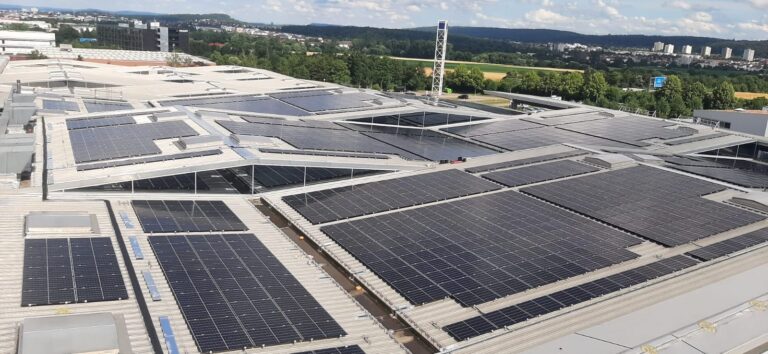
Distributed rooftop solar – installed on commercial and industrial buildings – operates at the point of consumption, bypassing grid constraints entirely. Systems can be deployed in weeks rather than years. Revenue begins at commissioning. And when aggregated across hundreds of sites with diversified counterparties and long-term PPAs, these assets start to resemble the contracted infrastructure that funds already target. The emerging landscape of distributed rooftop solar infrastructure in Europe represents one of the continent’s largest untapped asset bases, estimated at 2 to 3 TWp of rooftop potential according to industry analyses.
For fund managers considering how to allocate capital to solar assets in 2025 and beyond, the distributed segment introduces a new dimension. The per-unit asset size is smaller, but the portfolio effect – geographic diversification, counterparty spread, and operational repeatability – can produce risk-adjusted profiles comparable to or better than single-site utility-scale investments. Managing counterparty risk in long-term solar PPAs becomes an essential consideration in this context, particularly when contracting across SME offtakers.
| Criteria | Utility-Scale Solar Allocation | Distributed Portfolio Allocation |
|---|---|---|
| Typical asset size | 50-500 MW single site | 50 kW-1 MW per site, aggregated into portfolios |
| Deployment timeline | 2-5 years (permitting + grid connection) | Weeks to months per site |
| Grid dependency | High – requires grid connection and capacity | Low – behind-the-meter generation |
| Counterparty concentration | Single or few offtakers | Diversified across many SME offtakers |
| Revenue structure | Long-term PPA or merchant exposure | Long-term PPA with on-site consumption |
| Scalability model | Project-by-project development | Platform-driven, repeatable deployment |
| Capital efficiency | Large upfront commitment per project | Incremental deployment, faster capital recycling |
How Infrastructure Funds Will Allocate Capital to Solar Assets Going Forward
The forward outlook for how infrastructure funds allocate capital to solar assets points toward a blended approach. Utility-scale solar will remain a core allocation for funds seeking large single-asset exposure. But the distributed segment is becoming a necessary complement – particularly for funds prioritising deployment speed, geographic diversification, and contracted revenue visibility.
According to Global Infrastructure Hub, more than $15 trillion in infrastructure investment is required globally by 2040, with energy transition assets commanding a growing share. Within that envelope, distributed solar represents a structurally underallocated segment. The assets exist – across millions of European commercial rooftops – but they have historically lacked the aggregation layer required to make them investable at institutional scale.
That gap is closing. Platforms like ENSOOL’s distributed solar platform are being built specifically to aggregate SME rooftops into portfolio structures with standardised deployment, long-term PPAs, and predictable cashflows. This is what enables infrastructure funds to allocate capital to solar assets in the distributed segment without sacrificing the portfolio characteristics they require. The transition from fragmented project development to platform-based infrastructure is what will define the next phase of capital allocation in European solar.
Frequently Asked Questions About How Infrastructure Funds Allocate Capital to Solar Assets
What criteria do infrastructure funds use to allocate capital to solar assets?
How do infrastructure funds allocate capital to distributed solar versus utility-scale?
Why is capital allocation to solar assets in Europe accelerating?
What risks do infrastructure funds face when allocating to solar assets?
The question of how infrastructure funds allocate capital to solar assets is no longer confined to selecting between utility-scale projects. The market is evolving toward platform-based models that can aggregate distributed assets into scalable, contracted portfolios. Europe’s rooftop solar potential remains one of the continent’s most significant untapped infrastructure opportunities – not because capacity is lacking, but because the structure to channel institutional capital into it is only now being built. ENSOOL is positioned at exactly this transition point, building the aggregation infrastructure that connects institutional capital with Europe’s distributed solar asset base.